Introduction
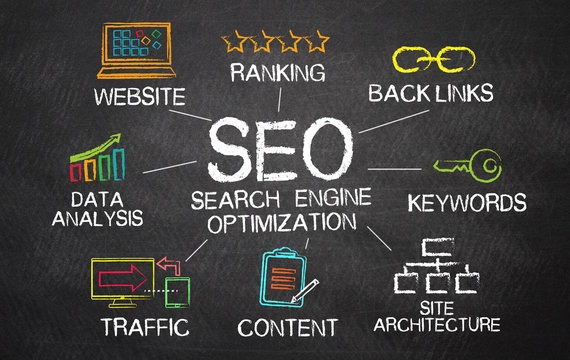
Being highly ranked on Google is not only advantageous in the cutthroat digital world of today, but also necessary. Your success depends on how visible you are in search results, regardless of whether you manage a small business, personal blog, or online store. Building long-term online credibility, boosting organic traffic, and getting your website in front of the appropriate people all depend on search engine optimization, or SEO.
But how can you keep ahead of the competition when Google’s algorithms are always changing? In actuality, shortcuts and keyword stuffing are no longer important components of SEO. It involves putting into practice sustainable, intelligent tactics that enhance search engine optimization and user experience. Google rankings The top ten SEO techniques to quickly raise your Google rankings are covered in this tutorial. These tried-and-true methods will help you stay up to speed with Google’s most recent changes while optimizing your content, organizing your website efficiently, and drawing in the proper kind of visitors. The top ten SEO techniques to quickly raise your Google rankings are covered in this tutorial. These tried-and-true methods will help you stay up to speed with Google’s most recent changes while optimizing your content, organizing your website efficiently, and drawing in the proper kind of visitors. In today’s competitive digital world, having a high Google ranking is not only beneficial but also vital. Whether you run a huge e-commerce store, a personal blog, or a small business, your visibility in search results is crucial to your online success. More exposure, more organic traffic, and a better likelihood of connecting with your target audience are all associated with high rankings. In summary, having a solid grasp of search engine optimization, or SEO, is essential to getting your website in front of the proper people. But it might be hard to stay on top of SEO. Because Google’s algorithms are always changing, what worked a year ago or even a month ago could not work today. Many website owners continue to use antiquated strategies like spamming backlinks and keyword stuffing, only to discover that these approaches cause more harm than good. Quality, relevancy, and user experience are the three main focuses of modern SEO. Google rankings Its main goal is to establish long-term trust by using intelligent optimization techniques that complement Google’s ranking goals along with regular, worthwhile content.
You must implement durable and successful SEO strategies SEO tips if you want to remain competitive. This entails making your website user-friendly for both search engines and people. Clear navigation, captivating images, mobile friendliness, and quick-loading sites are all important for retaining users on your site longer—and Google rewards that kind of engagement. Meanwhile, high-quality content optimized with strategic keywords continues to be one of the most powerful tools for boosting visibility.
What Is SEO? SEO TIPS
Having a website is insufficient in today’s digital environment; it must be visible, easily accessible, and appealing to your target audience. Search Engine Optimization, or SEO, can help with that. Enhancing your website to make it more visible when people use search engines like Google, Bing, or Yahoo to look for goods, services, or information about your company is known as SEO. Your website is more likely to draw in visitors and prospective buyers if it ranks higher on search engine results pages (SERPs). Google rankings
Understanding How SEO Works
Search engines use crawlers (or bots) to scan web pages, collect information, and store it in their index. Google rankings When a user performs a search, the search engine’s algorithm analyzes its index to deliver the most relevant results.
SEO helps you optimize your content and website structure so that search engines can easily understand and rank it. The goal is to align your website with what search engines consider valuable and what users are searching for.
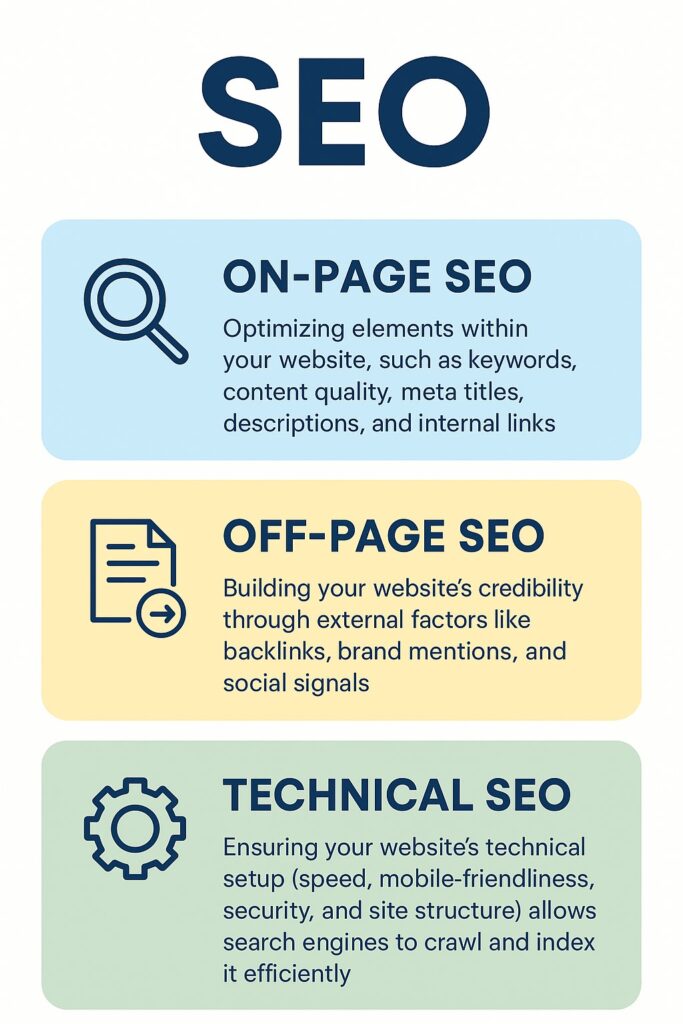
SEO involves three main components:
The Three Pillars of SEO: On-Page, Off-Page, and Technical SEO
The practice of making a website more visible on search engines like Google is known as search engine optimization, or SEO. It makes it simpler for search engines to comprehend, rank, and provide your material to appropriate audiences, which increases the amount of organic (non-paid) traffic to your website. On-page SEO, off-page SEO, and technical SEO are the three main categories into which SEO may be separated. To get good search performance, each is essential. Google rankings One of the most important tactics in modern digital marketing is search engine optimization, or SEO. In order to increase a website’s visibility and appeal to search engines like Google, Bing, or Yahoo, it is necessary to optimize it. Effective SEO raises a website’s position on search engine results pages (SERPs), drawing in more natural (non-paid) traffic. To reach their target audiences, enhance their online presence, and boost conversions, businesses, organizations, and individuals all employ SEO. But SEO is not a single procedure; rather, it is a group of methods that are divided into various categories and have distinct functions. Creating a comprehensive and effective digital marketing strategy requires an understanding of the many forms of SEO.
1. On-Page SEO
On-Page SEO focuses on optimizing the elements that exist directly on your website. Google rankings Its goal is to make your pages more relevant and valuable to users and search engines.
Key components include:
- Keywords: Choosing and placing the right keywords throughout your content helps search engines understand what your page is about. Keywords should appear naturally in titles, headings, and the main text without “keyword stuffing.”
- Content Quality: High-quality, original, and informative content is the foundation of On-Page SEO. Content should answer the user’s intent, provide value, and encourage visitors to stay longer on your page. Regular updates and well-structured articles improve your credibility.
- Meta Titles and Descriptions: These are the first things users see in search results. A strong meta title should include the target keyword and attract clicks, while a compelling meta description should summarize the page’s content effectively.
- Internal Links: Linking relevant pages within your website helps search engines crawl your site more easily and helps users discover related content. This improves navigation, engagement, and page authority.
- Images and Media Optimization: Using descriptive filenames, alt tags, and compressed images helps search engines understand your visuals and improves page speed.
2. Off-Page SEO
Off-Page SEO involves activities performed outside your website to improve its authority and reputation. The main objective is to build trust and credibility in the eyes of search engines.
Key components include:
- Backlinks: Backlinks (links from other websites to yours) are one of the most important ranking factors. When reputable sites link to your pages, it signals to search engines that your content is valuable and trustworthy.
- Brand Mentions: Even if a website doesn’t link to you, mentions of your brand online still contribute to your digital presence and authority.
- Social Signals: Engagements on social media—likes, shares, and comments—don’t directly influence rankings but can increase visibility and drive traffic to your website.
- Guest Posting and Outreach: Writing high-quality articles for other websites or collaborating with influencers can help you gain valuable backlinks and expand your audience
3. Technical SEO
Technical SEO focuses on the backend structure and performance of your website. It ensures that search engines can efficiently crawl, interpret, and index your pages Google rankings.
Key components include:
- Website Speed: A fast-loading website improves user experience and search rankings. Slow sites can cause higher bounce rates and lower engagement.
- Mobile-Friendliness: Since most searches happen on mobile devices, your website must be responsive and display correctly on all screen sizes.
- Security (HTTPS): Having a secure website with an SSL certificate builds trust with users and search engines.
- Site Architecture: A clear and organized site structure helps both users and search engines navigate your website. Using sitemaps and clean URLs enhances crawlability.
- Crawlability and Indexing: Ensuring search engines can easily access and index your pages is essential. Tools like Google Search Console can help identify crawl errors or broken links.
Effective SEO Strategies
Making ensuring the correct people visit your website, interact with it, and convert is the goal of search engine optimization, or SEO. The main tactics to improve your SEO in 2025 and beyond are listed below, along with helpful advice and best practices.
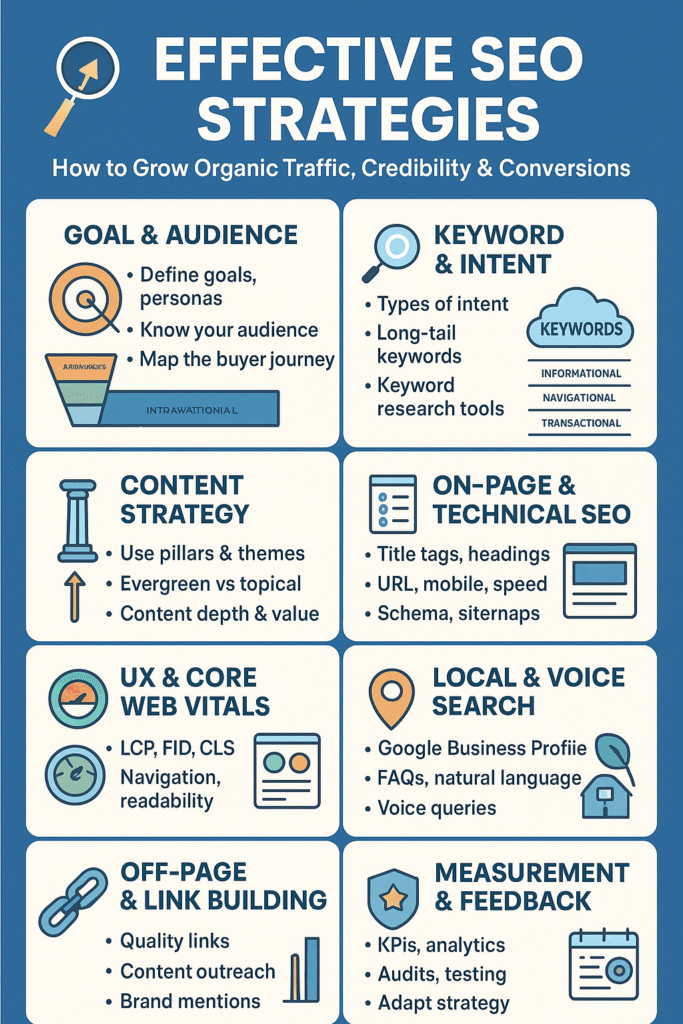
Table of Contents
- Understanding SEO & Its Importance
- Defining Goals, Audience & Personas
- Keyword Research & Search Intent
- Content Strategy & Pillars
- On-Page SEO: Structure & Elements
- Technical SEO
- User Experience & Core Web Vitals
- Mobile and Voice Search Optimization
- Local SEO
- Off-Page SEO & Link Building
- Analytics, Measurement & Feedback Loop
- Algorithm Updates & E-A-T (Expertise, Authority, Trust)
- Common Mistakes & How to Avoid Them
- SEO Workflow & Team Collaboration
- Future Trends
1. Understanding SEO & Its Importance
- Organic traffic is still one of the highest ROI channels—users find you because of relevance, not paid ads.
- Search engines like Google, Bing, etc., are evolving: they now use AI/ML, user behavior, mobile-first indexing, etc.
- High rankings build credibility, visibility, and trust. Users often equate top search results with authority.
- SEO is long term: compounding benefits. The more positive signals (good content, backlinks, speed, UX), the stronger your domain becomes.
2. Defining Goals, Audience & Personas
- Before doing anything, define what you want SEO to achieve: brand awareness, lead generation, sales, content subscriptions, etc.
- Identify target audience segments. Build detailed personas:
- Demographics (age, education, location)
- Psychographics (interests, pain points, motivations)
- Search behavior: what do they search, how, from where, on which devices.
- Map the buyer’s journey (awareness → consideration → decision) to SEO content types. Each stage needs different kinds of content and calls-to-action.
3. Keyword Research & Search Intent
- Types of search intent: informational (learning), navigational, transactional (buying), commercial (comparison).
- Use tools like Google Keyword Planner, Ahrefs, SEMrush, Ubersuggest etc. to find keyword ideas.
- Long-tail keywords are especially valuable: less competition, more specific, often higher conversion.
- Check what competitors rank for: what keywords they target, what content they have, where there are gaps you can fill.
- Analyze keyword difficulty vs search volume. Some high volume keywords may be very difficult—balance with achievable ones.
- Always align content with intent—if someone searches “how to bake bread”, they expect a recipe / tutorial, not a page trying to sell ovens.
4. Content Strategy & Pillars
- Use topical pillars: core themes central to your business or domain. Around each pillar build several related sub-topics / articles. This helps establish authority and context.
- Types of content: blog posts, guides, how-tos, case studies, whitepapers, FAQs, video or audio, infographics.
- Evergreen content vs timely content: maintain a mix. Update evergreen pieces so they stay relevant.
- Content depth matters: longer, detailed content often performs better—but clarity & structure are important (headings, subheads, readability).
- Unique value: include original research, data, insights, visuals. Avoid repeating what’s already out there unless you add a fresh angle.
5. On-Page SEO: Structure & Elements
- Title tags: concise, keyword-rich, click-worthy. Keep them under ~60 characters.
- Meta descriptions: though they don’t directly impact ranking, they affect click-through rates (CTRs). Use clear language, include primary keyword, call-to-action.
- Headings (H1, H2, H3 …): logical structure; help both users and search engine crawlers. Include keywords where appropriate.
- URL structure: clean, readable, descriptive; include keywords. Avoid long strings, parameters if possible.
- Internal linking: link to related content to distribute authority, reduce bounce, improve session time. Anchor texts should be relevant.
- Images & multimedia: use alt text, optimize sizes, lazy load; multimedia can boost engagement.
- Schema / structured data: helps search engines understand context, enable rich snippets, which can increase visibility in SERPs.
6. Technical SEO
- Website speed / performance: minimize CSS/JS, use caching, optimize images, use a content delivery network (CDN).
- Mobile-first indexing: site must perform well on mobile devices; responsive design; touch targets suitably sized.
- Secure site (HTTPS): non-negotiable from both trust and ranking perspectives.
- XML sitemap & robots.txt: ensure correct indexing; exclude what shouldn’t be indexed.
- Canonical tags: avoid duplicate content issues.
- Clean site architecture / crawlability: shallow depth for pages, logic in folder structure.
- 404 errors, broken links: monitor and fix.
- Pagination handling, infinite scroll etc.: ensure search engines can crawl content, don’t hide important content.
7. User Experience & Core Web Vitals
- Core Web Vitals (as per Google): LCP (Largest Contentful Paint), FID (First Input Delay), CLS (Cumulative Layout Shift). Improving these improves rankings and reduces bounce.
- Clear, intuitive navigation.
- Readable typography: font size, line spacing, contrast.
- Avoid intrusive popups / interstitials.
- Fast, smooth interactions.
- Minimize annoying ads or anything that distracts / slows user.
8. Mobile & Voice Search Optimization
- As usage of mobile devices and voice assistants (Google Assistant, Siri, Alexa) increases, content needs to adapt.
- Use conversational / natural language in content; many voice searches are in question form (“How do I…?”, “What is…?”, “Where can I…?”).
- FAQs and Q&A format content helps. Google rankings
- Optimize for speed and lightweight pages (because many voice searches happen on mobile).
- Make sure touch elements are big enough; navigation works well on small screens.
9. Local SEO
- If your business has a physical location or serves local customers, local SEO is vital.
- Google Business Profile (GBP): fill all info, hours, photos, posts, reviews.
- Local citations: consistent name, address, phone (NAP) across directories.
- Localized content: write blog posts or pages about local events, landmarks, or customer stories.
- Schema markup for local businesses.
- Reviews: actively ask customers for reviews; respond to reviews (positive & negative).
- Local link building: partner with local organizations, events, media.
10. Off-Page SEO & Link Building
- Quality over quantity: a few good links from high authority, relevant domains is better than many low quality ones.
- Natural link building: produce content so good others want to link (resource pages, guides, studies).
- Content promotion: outreach (blogs, influencers), social media, guest posting.
- Monitor backlink profile: disavow spam links. Use tools to check incoming links.
- Also think about brand mentions (even unlinked); encourage media or bloggers to link.
11. Analytics, Measurement & Feedback Loop
- Use tools like Google Analytics, Search Console, Bing Webmaster Tools.
- Set clear KPIs: organic traffic, keyword ranking, CTR, bounce rate, dwell time, conversion rate.
- Regular audits (technical, content, links).
- A/B test page layouts, titles, meta descriptions where possible.
- Use user feedback, heat maps, session recordings to understand user behavior.
- Adjust strategy based on data: drop underperforming keywords/content, enhance successful topics.
12. Algorithm Updates & E-A-T (Expertise, Authority, Trust)
- Stay updated with major search engine algorithm changes. Google often publishes broad updates, but many updates are under the hood.
- E-A-T is increasingly important: content should show expertise (credentials, author bio), authority (recognition by others, links, citations), and trust (secure site, good reviews, transparency).
- Avoid black-hat techniques: keyword stuffing, cloaking, buying links. These may lead to penalties.
13. Common Mistakes & How to Avoid Them
- Keyword stuffing / over-optimization: trying to force too many keywords harms readability and may lead to penalties.
- Thin content: pages with very low content, or duplicate content, or shallow details.
- Ignoring mobile users: slow on mobile, bad UI.
- Poor site speed: large images, bloated scripts, unoptimized hosting.
- Neglecting internal linking: content becomes isolated, search engines can’t discover it well.
- Not maintaining old content: broken links, outdated statistics, obsolete info. Refresh regularly.
- Setting wrong expectations: thinking SEO is instant. It takes time, consistent effort.
14. SEO Workflow & Team Collaboration
- Roles: content creators, SEO specialists, web developers, UX designers, analytics experts. Define who does what.
- Content calendar: plan ahead for topical content, seasonal trends, campaigns.
- Collaboration between content & dev teams early (e.g. for site architecture, technical SEO).
- Regular internal SEO training: keep everyone aware of basics.
- Tools: shared documentation, dashboards, project management tools to track SEO tasks.
15. Future Trends
- Growing role of AI / ML: search engines are getting better; content generation tools also increasing. Must differentiate with human insights, originality.
- Generative search interfaces: search engines may directly answer via AI—your content needs to be structured to be cited.
- Visual search, video content becoming more important. Optimize video metadata, transcripts.
- Searcher experience signals (time on site, bounce, scroll depth) increasingly tied to ranking.
- More importance to privacy, data security, as regulations grow.
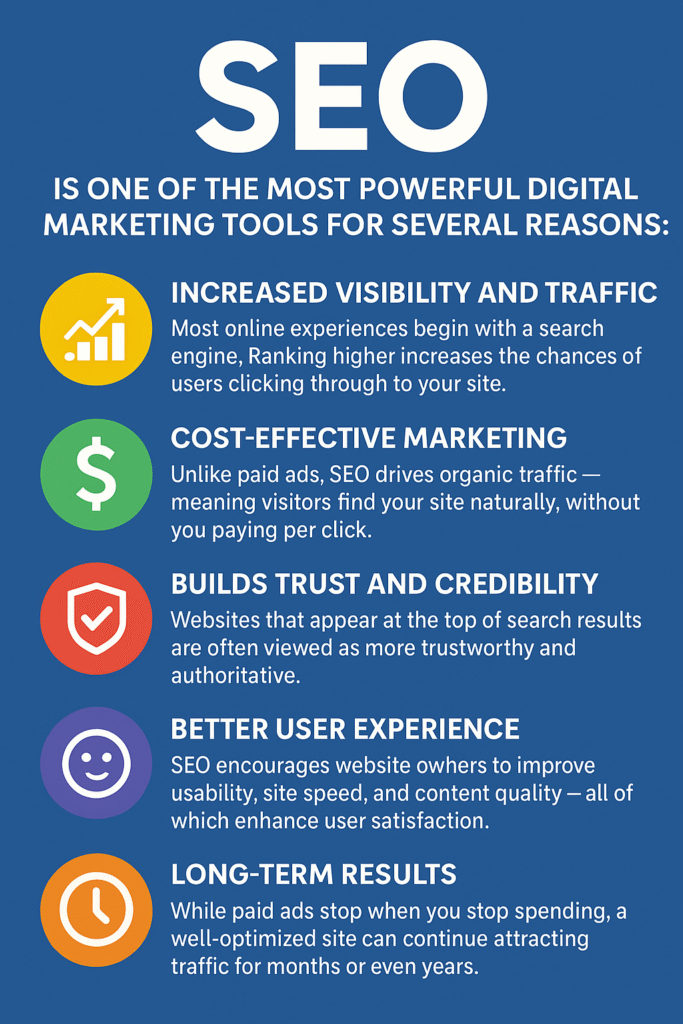
Why SEO Is Important
The cornerstone of any effective digital marketing plan is search engine optimization, or SEO. It is the process of improving your website so that it appears higher in search results on sites like Yahoo, Bing, and Google. When done properly, SEO promotes long-term growth and brand authority in addition to increasing visibility. SEO provides long-term advantages that grow over time, in contrast to other marketing strategies that require constant investment. Let’s examine the reasons SEO is such an effective digital marketing strategy.
> Increased Visibility and Organic Traffic
The majority of internet adventures begin with a search engine query. People usually use Google first while searching for goods, services, or information. Your website’s chances of receiving clicks and visits are significantly increased when you rank on the first page, particularly in the top three results. In order for search engines to comprehend and suggest your website to users looking for related topics, SEO helps you optimize your content, website structure, and technical components. Without depending only on paid advertising, this translates into increased visibility, traffic, and a more robust online presence.
Because organic traffic is made up of people who are actively looking for what you have to offer, it is extremely valuable. These visitors are more likely to become leads or customers because they are already engaged in your niche.
> Cost-Effective and Sustainable Marketing.
SEO is incredibly economical when compared to both digital and traditional advertising. Although it necessitates a one-time investment in tools, optimization, and content production, the long-term benefits are significant. In contrast to pay-per-click (PPC) efforts, which lose traffic as soon as you stop spending money, SEO keeps producing results even after your budget runs out. With little maintenance, your pages can generate consistent organic traffic for months or even years after they rank well.
Because of its sustainability, SEO is among the best digital marketing techniques, particularly for small and medium-sized enterprises looking to expand without spending a lot of money on advertising.
> Builds Trust, Authority, and Credibility
People naturally trust search engines. When Google places your website at the top of search results, it’s seen as an endorsement of your site’s quality and relevance. High-ranking websites are perceived as more credible and authoritative. Google rankings SEO involves creating valuable, accurate, and engaging content that demonstrates your expertise. Additionally, obtaining backlinks from other reputable sites further enhances your authority in your industry.
Over time, consistent optimization helps your brand build a strong reputation online. Users begin to associate your brand with reliability, which fosters trust — an essential element for long-term customer relationships.
> Enhances User Experience
Modern SEO goes far beyond keywords and backlinks. It’s deeply connected with user experience (UX). Search engines like Google now prioritize websites that provide users with fast, mobile-friendly, and easy-to-navigate experiences.
Key aspects of UX that SEO influences include:
- Website speed: Faster sites keep users engaged and reduce bounce rates.
- Mobile responsiveness: With the majority of searches happening on mobile devices, optimization for all screen sizes is vital.
- Clear structure and navigation: A well-organized site helps both users and search engines find information easily.
- High-quality content: SEO encourages the creation of informative, relevant, and well-written content that addresses user needs.
> Long-Term and Compounding Results
SEO has an enduring effect, in contrast to short-term marketing initiatives. Even if you cut back on active promotion, your website can still draw organic traffic if it has high ranks.
Every optimized piece of content, backlink obtained, and site performance boost adds up over time, making SEO a cumulative process. Future content will rank more quickly and effortlessly as your domain becomes more authoritative.
Compared to paid initiatives that stop when the cash runs out, SEO’s outcomes are more consistent and long-lasting, even though it does demand patience and constant improvement. It is therefore essential to long-term digital progress Google rankings.
> Improves Brand Awareness and Competitive Edge
In addition to increasing clicks, ranking on the top page enhances brand recognition. Seeing your brand name in the top results on a regular basis fosters familiarity and trust, even if visitors don’t click on your link right away. Additionally, SEO makes it possible for smaller companies to compete with larger ones. Even startups may outrank large companies with relevant, well-optimized content by focusing on long-tail keywords and niche markets.
Because of this level playing field, SEO is a tactical tool that companies of all sizes can use.
> Provides Valuable Insights and Measurable Results
Comprehensive insights into user behavior, keyword performance, and content engagement are provided by SEO tools and analytics platforms. You can monitor what’s effective, including which keywords generate the most traffic, which pages convert the best, and where users abandon the site. Continuous optimization is made possible by this data-driven strategy, which guarantees that your marketing choices are grounded in actual user trends rather than conjecture.
SEO is not only a traffic generator but also a potent market intelligence tool since these insights can eventually be used to guide more comprehensive marketing and commercial initiatives.
Key Elements of SEO
To make Search Engine Optimization (SEO) truly effective, you need to focus on several core elements that work together to improve your website’s visibility, relevance, and authority in search results. Google rankings SEO is not just about inserting keywords — it’s about building a website that search engines and users both trust and value.
Let’s explore the key elements that form the foundation of a powerful SEO strategy.
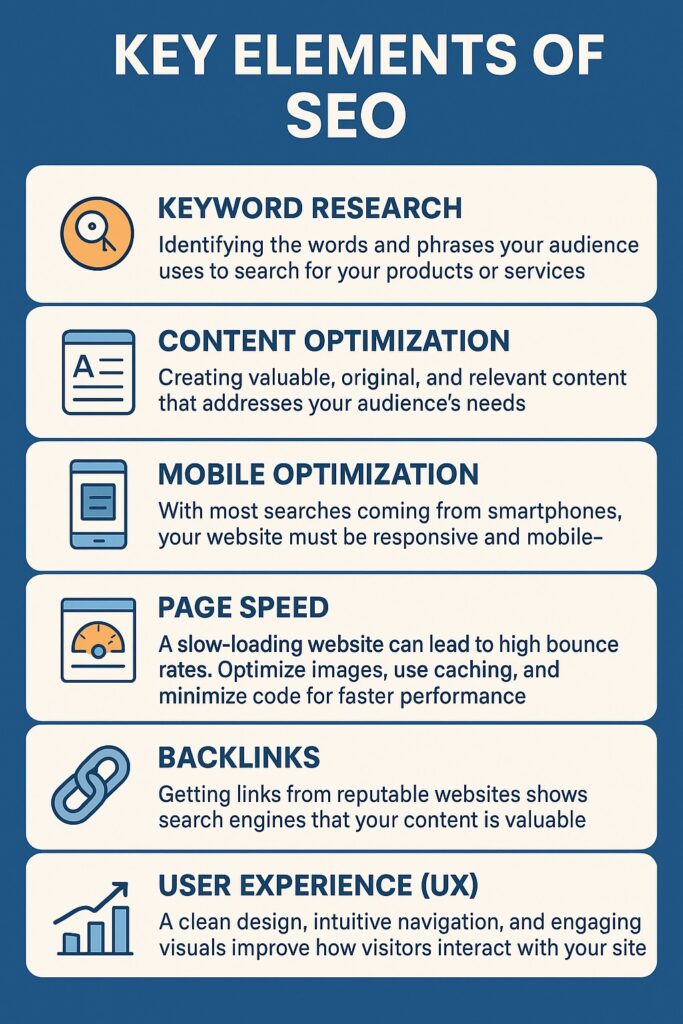
~Keyword Research – The Foundation of SEO
Keyword research is the starting point of any successful SEO campaign. It involves identifying the words and phrases your target audience types into search engines when looking for your products, services, or information.
By understanding what your audience is searching for, you can tailor your content to match their intent — ensuring that your website appears when they need it most.
Key steps in keyword research:
- Use tools like Google Keyword Planner, Ahrefs, SEMrush, or Ubersuggest to discover relevant keywords.
- Focus on long-tail keywords (e.g., “best running shoes for flat feet”) rather than just generic ones (“shoes”), as they’re less competitive and often bring higher conversion rates.
- Analyze search intent — whether users want information (informational), a specific website (navigational), or to make a purchase (transactional).
- Study your competitors to find keyword gaps and opportunities.
~Content Optimization – Creating Value and Relevance
The next step after determining what people are looking for is to provide excellent, optimized content. Websites that offer genuine value to users, rather than just pages with a lot of keywords, are rewarded by search engines.
Content that has been optimized is interesting, educational, and provides straightforward answers to the user’s queries. Additionally, it ought to match the search intent SEO tips. Google rankings
Effective content optimization involves:
- Natural keyword integration: Place keywords in titles, subheadings, and throughout the body without forcing them.
- Compelling meta titles and descriptions: These attract users to click on your content in search results.
- Rich formatting: Use bullet points, images, videos, and short paragraphs to make content easy to scan.
- Internal linking: Link related pages and articles within your site to help users and search engines discover more content.
- Regular updates: Refresh outdated information, add new data, and improve readability to maintain rankings.
~Mobile Optimization – Reaching the Modern User
With the majority of searches now coming from smartphones and tablets, mobile optimization has become a critical SEO element. Google’s mobile-first indexing means it primarily evaluates your site’s mobile version to determine rankings.
Key aspects of mobile optimization include:
- Responsive design: Your website should automatically adjust to different screen sizes and orientations.
- Readable text and clear navigation: Avoid small fonts or crowded menus.
- Touch-friendly buttons: Make sure clickable elements are large and easy to tap.
- Fast mobile loading speed: Compress images and minimize scripts for quick access.
- Avoid intrusive popups: They frustrate mobile users and can hurt your rankings.
~Page Speed – Faster Sites Win
Page speed is one of the most important technical factors in SEO. A slow-loading website frustrates users and increases bounce rates. In fact, research shows that 53% of mobile visitors leave a site if it takes more than three seconds to load.
Search engines prioritize sites that load quickly because they offer a better user experience.
Ways to improve page speed:
- Optimize images: Use proper file formats (e.g., WebP), compress large files, and add lazy loading.
- Minimize code: Remove unnecessary CSS, JavaScript, and HTML elements.
- Use browser caching: Store certain elements locally so returning users experience faster load times.
- Use a CDN (Content Delivery Network): This distributes your content across multiple servers worldwide for faster access.
- Upgrade hosting: Choose a reliable hosting provider with fast server response times.
~Backlinks – Building Authority and Trust
Links going to your website from other websites are known as backlinks or inbound links. They serve as endorsements that let search engines know your material is reliable and worthwhile. But not every backlink is made equal. Numerous links from irrelevant or low-quality websites are worth much less than one link from a respectable, high-authority website.
Techniques for obtaining high-quality backlinks:
Make original, shareable content: Guides, infographics, and stories with a strong data focus are more likely to get links.
Guest blogging: Compose excellent content for respectable websites in your field.
Develop connections: Make contact with bloggers, influencers, and companies to discuss possible joint ventures.
Keep an eye on backlinks: Track your link profile and disavow spammy links with tools like Ahrefs or SEMrush.
~User Experience (UX) – Keeping Visitors Engaged
A great user experience isn’t just about aesthetics — it’s about how easily visitors can find what they need and how enjoyable it is to interact with your website. Google rankings Search engines track user behavior, such as bounce rate, time on site, and click-through rate, to measure engagement. If users leave quickly, it signals poor relevance or usability.
To enhance UX:
- Simplify navigation: Use clear menus and logical site structure.
- Readable design: Choose clean layouts, readable fonts, and sufficient white space.
- Engaging visuals: Add images, charts, and videos that support your message.
- Accessibility: Ensure your site works well for all users, including those with disabilities.
- Call-to-action (CTA): Guide users toward taking the next step — signing up, buying, or contacting you.
~Analytics and Tracking – Measuring Success
You can’t improve what you don’t measure. Analytics and tracking are crucial for understanding how your SEO strategy performs and where it needs refinement.
Key tools and metrics:
- Google Analytics: Tracks user behavior, traffic sources, engagement, and conversions.
- Google Search Console: Monitors keyword rankings, indexing status, and site errors.
- Heatmaps and behavior tools: Understand how users interact with your site.
Important SEO metrics to track:
- Organic traffic growth
- Keyword rankings
- Click-through rates (CTR)
- Bounce rate and dwell time
- Conversion rate
The Future of SEO
The future of SEO is becoming more intelligent and user-focused as search engines evolve with artificial intelligence and machine learning. Instead of simply matching keywords, Google now aims to understand user intent — for example, when someone searches “best running shoes,” it prioritizes pages that compare top brands and include user reviews, not just sites stuffed with keywords. Voice search is another growing trend; people now ask devices like Alexa or Google Assistant questions in a conversational tone, such as “What’s the nearest coffee shop open now?” — so optimizing for natural, question-based phrases is essential. Similarly, visual search tools like Google Lens allow users to search using images, making it important to add descriptive alt text and structured data to images. Businesses that focus on local SEO — for example, by keeping their Google Business Profile updated — can attract nearby customers searching for “digital marketing agency near me.” Overall, the future of SEO lies in creating valuable, authentic, and technically optimized content that provides a seamless user experience while adapting to new technologies and search behaviors.
Conclusion
The article “SEO Strategies to Boost Your Google Rankings Fast” from samuel.digitalschampions.in provides a clear and comprehensive overview of effective SEO techniques, covering essential areas such as on-page optimization, technical SEO, link building, and user experience. It aligns well with current SEO practices by emphasizing factors like mobile responsiveness, site speed, and quality content creation. However, while informative, much of its content is fairly generic and lacks original insights or real-world case studies to make it stand out. Google rankingsThe promise of “fast” results can also be misleading, as SEO typically delivers long-term rather than instant outcomes. Overall, the article serves as a strong beginner-friendly guide to understanding and implementing SEO strategies but would benefit from deeper analysis, data-driven examples, and updated references to strengthen its credibility and impact.