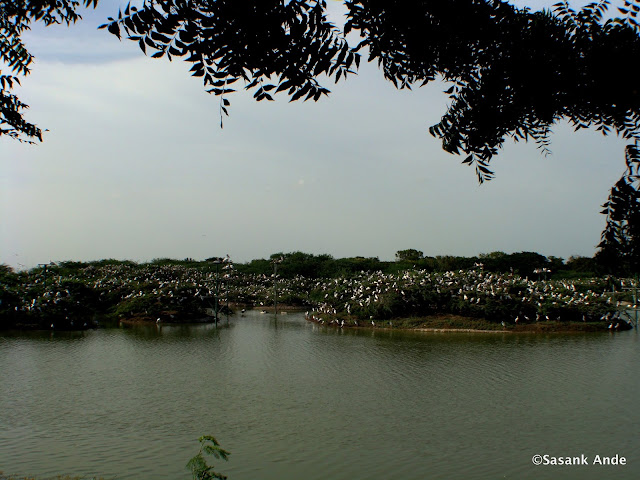
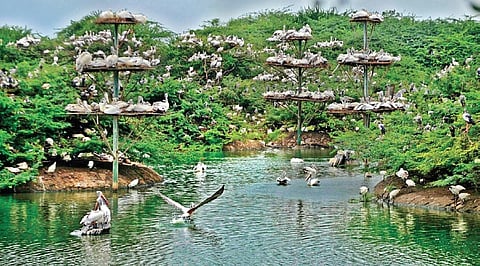
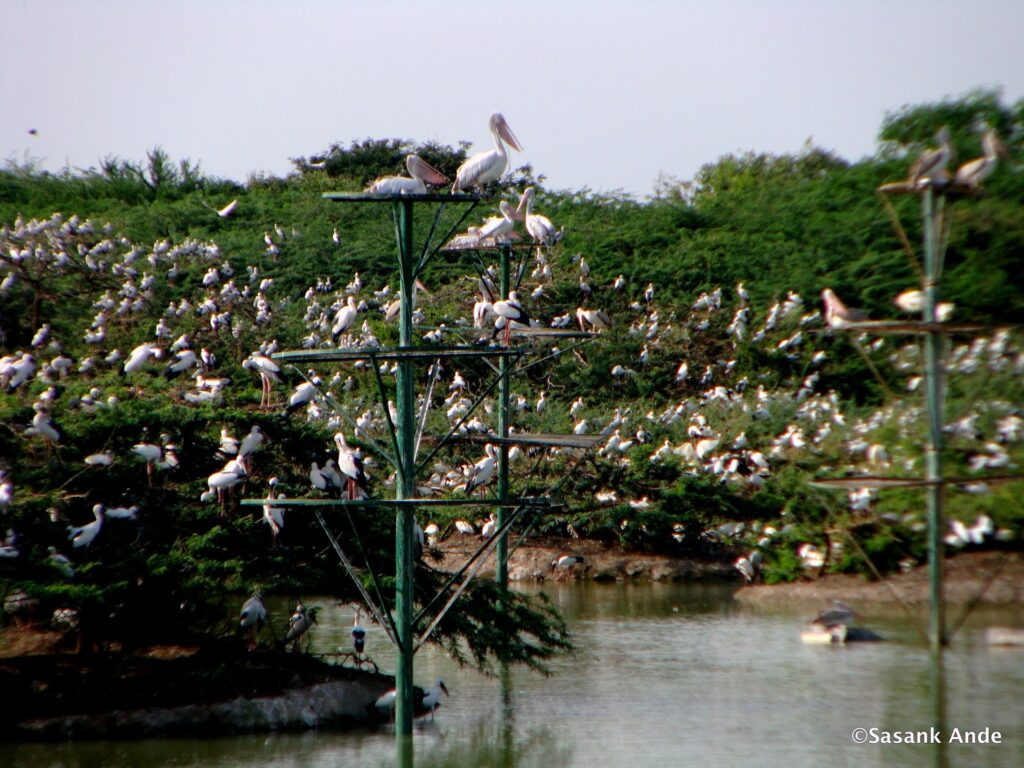
Best Bird Sanctuaries in South India|Uppalapadu Sanctuary. Uppalapadu, close to Guntur City, India, is home to the Uppalapadu Bird Sanctuary. The village water tanks are used for nesting by migratory birds from Siberia, Australia, and other places, including painted storks and spot-billed pelicans.In the past, there were roughly 12,000 birds in these tanks, but these days, only about 7000 birds spend the year roosting in this diminishing habitat. However, certain actions have been made, such planting artificial trees, raising awareness in the community, and providing the ponds with enough water, among other things. There might be more than 1500 pelicans. In addition to these six pintail ducks, two stilts, five red-crested pochards (Rhodonesa rufina), a few cormorants, and common coots and common teals were also observed.The forest authorities ought to plant more Prosopis velutina trees in and around this wetland rather than installing wire mesh artificial trees. Along with the jungle crow, the ibises and painted stork were observed foraging on the pelican’s leftover, rotten fish droppings. Both fresh and saltwater fish were the primary food source for the chicks. Some of the fish that had fallen from the nests were fresh and weighed around 0.8 kg, especially LabeoRohita (Carp) and other sea fish. Since the pelicans were not observed fishing from the local ponds, they must have been transported from the closest river and sea, which is roughly 20 to 30 kilometers from the location. Although they did not do so in the early years, pelicans are already using the enormous wire mesh trees that the Forest Department provided in 2009 to build their nests. 2009 marked the end of this pelicanary’s ten-year run. Now, some pelicans have chosen to use Ramchandrapalem, another pond, which is roughly 4 km away from this location and heading towards Guntur.Best Bird Sanctuaries in South India|Uppalapadu Sanctuary.Working together, local businesses, environmentalists, and government officials have maintained this natural refuge. Attracting and preserving the varied avian population has been much aided by projects including building artificial nesting platforms, keeping water levels in ponds, and guaranteeing a safe environment for the birds.Ornithologists and birdwatchers would find the refuge perfect since it hosts more than forty kinds of migratory and permanent birds. “From striking painted storks and spot-billed pelicans to the elegant black-headed ibis and the vibrant common teal, the diversity of avian life here is nothing short of spectacular,” said V Nari, Development Convenor for Uppalapadu Bird Sanctuary.After March, the birds deposit their eggs, hatch them, and then return to their natural habitats bearing young. Seeing these migratory wonders is breathtaking since they turn the refuge into a vivid patchwork of feathers and flying. Regular visitors to the refuge for field excursions are several bird enthusiasts and students from surrounding colleges, eager to see this natural show.
Uppalapadu Bird Sanctuary: Best Bird Sanctuary in South India
Many resident and migrating bird species depend on several well-known bird sanctuaries found in South India. Among such important havens is the Uppalapadu Bird Sanctuary near Guntur, Andhra Pradesh.
Uppalapadu Bird Sanctuary: An Overview
Situated on the outskirts of Guntur city, Uppalapadu Bird Sanctuary is a vibrant avian refuge well-known for its great diversity and scenic surroundings. The refuge is mostly made of a group of water tanks that give numerous bird species a perfect place for nesting and breeding. Especially in the winter, it draws a great range of migrating species.
Species of Birds and Biodiversity
Among numerous species, the refuge is a major home for the endangered Spot-billed Pelicans, Painted Storks, Openbill Storks, Black-headed Ibises, and Cormorants. A perfect place for birdwatching, the number of birds can reach over 10,000 during the busiest migratory season, from October to March.
Conservation Activities
Together with local conservation groups, the Andhra Pradesh Forest Department has taken major action to safeguard the birds and their habitats in Uppalapadu. Regular maintenance of water bodies and awareness campaigns help the nearby population to understand the need of protecting these ecosystems.Best Bird Sanctuaries in South India|Uppalapadu Sanctuary.October to March is the ideal time to visit Uppalapadu Bird Sanctuary since it is teeming with migrating birds at that period. A captivating natural show is created by visitors seeing swarms of pelicans, ibis, and other species sleeping in the trees and water bodies. Observation decks and shelters for photographers and birdwatchers abound throughout the refuge as well.
How to arrive to Uppalapadu?
About 7km from Guntur city, Uppalapadu is conveniently reachable by road. About 50 km away, Vijayawada Airport is the closest airport; Guntur is the closest railway station.Other Notable Bird sanctuaries located in South India.Renowned for houseboat trips and migratory birds, Kumarakom Bird Sanctuary in Kerala. Crocodile sightings and birdwatchers will find paradise at Ranganathittu Bird Sanctuary, Karnataka. Among India’s oldest bird sanctuaries, Vedanthangal Bird Sanctuary in Tamil Nadu is well-known for drawing plenty of migratory species. Andhra Pradesh’s Kolleru Lake Bird Sanctuary: A freshwater lake drawing plenty of birdlife. Nature lovers and bird aficionados in South India should definitely visit Uppalapadu Bird Sanctuary since it is notable for its special mix of natural beauty and great avian variety.
Bird Species and Biodiversity | Eco-Tourism in Guntur.
Biodiversity and Bird Species
A wide variety of bird species, both migratory and resident, may be found in Uppalapadu Bird Sanctuary. Here, some of the most common bird species are:
1. The Spot-billed Pelican
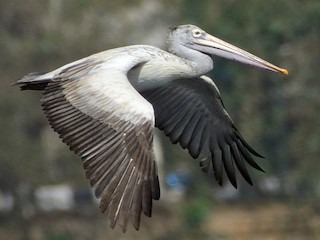
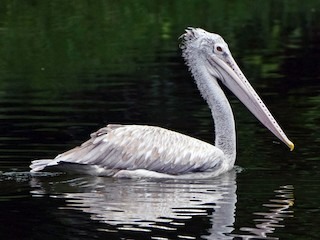
Though it is very small for a pelican, the spot-billed pelican is a rather big water bird, usually the biggest or one of the largest native birds in the southern parts of its habitat. Long 125– 152 cm (49–60 in), it weighs 4.1–6 kg (9.0–13.2 lb). While the usually big beak ranged from 285 to 355 mm (11.2 to 14.0 in), the wingspan can vary from 213 to 250 cm (7 ft 0 in to 8 ft 2 in). [6] It has a grey crest, hindneck and a brownish tail; it is white mostly. The greyish nape crest formed by the curled feathers on the rear neck Additionally seen on the sides of the upper mandible, the pouch is pink to purplish with big pale patches. The tip of the bill—or nail—is yellow to orange. The skin at the base of the beak is dark in breeding plumage; the orbital patch is pink. Though the tertials and inner secondaries are darker and a pale line runs down the larger coverts, in flight they seem not unlike the Dalmatian pelican. The tail has a rounder form.Best Bird Sanctuaries in South India|Uppalapadu Sanctuary.
The chicks that have just hatched are white down coated. Then they moul into a greyish speckled plumage. The bill’s spots show just after a year. Their third year brings the whole adult breeding plumage.
2. Stork with paint
A big wader in the stork family is the painted stork (Mycteria leucocephala). It is found on the Indian Subcontinent’s plains of tropical Asia south of the Himalayas, in the marshes. This stretches into Southeast Asia. Their name comes from their unique pink tertial feathers for the adults. They gather in flocks in shallow waters beside lakes or rivers. They submerge their half open beaks in water, sweep them from side to side, and capture their prey—small fish sensed by touch. Their feet ruffle the water as they wade along to flush concealed fish. Often along with other waterbirds, they nest colonially on trees. Their sole sounds are feeble sighs or bill clattering at the nest. In other areas of their range, they merely conduct short-distance excursions in reaction to changes in temperature or food supply or for breeding; they are not migratory. Like other storks, they are frequently seen soaring on thermals.
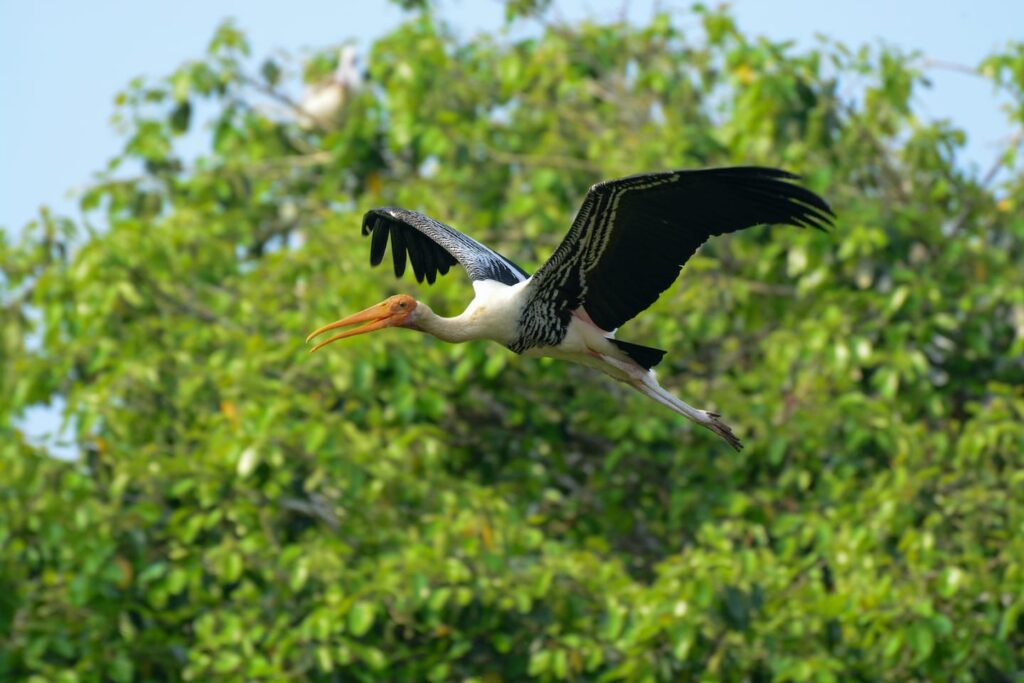
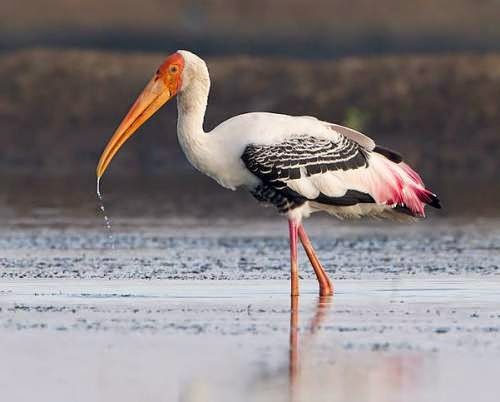
This big stork looks like an ibis because of its heavy yellow beak with down-curved tip. The adult’s head is naked and either orange or reddish. The lengthy tertials rest across the back and rump and are capped in brilliant pink. There is a clearly black breast band with white scaly patterns. The band continues into the under-wing coverts, and the white tips of the black coverts give it the impression of white stripes running over the under-wing lining.Adults’ rest of the body is white; the primaries and secondaries are black with a greenish gloss. Because of their urohidrosis, or defecation on their legs particularly when at rest, the legs are yellowish to red yet often seem white. The black short tail glistens in green. Standing about 93–102 cm (36.5–40 in), 150–160 cm (59–63 in), weighing 2–3.5 kg (4.4–7.7 lb), a stork is medium-sized. Though they look same, men and women seem different; normally, the man of a couple is bigger than the female.
Mostly white with gray bills, the downy juveniles have blackish facial skin. Like most other storks, the young take a brownish plumage and attain breeding condition two to three years ago.Like other storks, they fly with their necks thrust forward.Best Bird Sanctuaries in South India|Uppalapadu Sanctuary. Frequently using the late morning thermals, they soar in search of foraging grounds. Mostly silent like other storks, they clatter their bills at the nest and may produce some harsh croaking or low groaning sounds there.
3. Stork Openbill
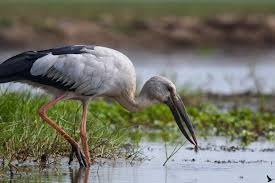
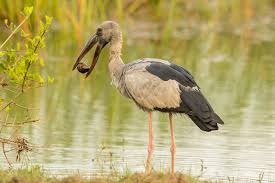
Large wading birds of the stork family Ciconiidae, the Asian openbill or Asian openbill stork (Anastomus oscitans) is Mostly widespread in the Indian subcontinent and Southeast Asia, this unusual stork Greyish or white, it has glossy black wings and tail. Thought to be an adaptation helping adults handle snails, their principal prey, adults have a space between the arched top jaw and recurved lower mandible. Young birds start their lives without this divide. Though they live within their range, they travel great distances in response to food availability and weather.
French polymath Georges-Louis Leclerc, Comte de Buffon, wrote about the Asian openbill in his Histoire Naturelle des Oiseaux from a specimen taken in Pondichery, India. Produced under Edme-Louis Daubenton’s direction, François-Nicolas Martinet’s hand-coloured plate etched in the Planches Enluminées D’Histoire Naturelle complemented Buffon’s text and illustrated the bird as well. Although Buffon’s description and the plate caption omitted a scientific name, in 1783 the Dutch naturalist Pieter Boddaert proposed the binomial name Ardea oscitans in his catalogue of the Planchées Enluminées. Now housed in the genus Anastomus, created by French naturalist Pierre Bonnaterre in 1791, is the Asian openbill. Anastomus is derived from the ancient Greek αναστoμοω, meaning “to furnish with a mouth” or “with mouth wide-opened”. The Latin word for “yawning” is oscitan, the specific epithet.
With glossy black wings and tail shined in green or purple, the Asian openbill stork is mostly grayish (non-breeding season) or white (breeding season). The name comes from the unique gap that adult birds’ beak’s recurved lower and arched upper jaw leaves. Young birds do not have this disparity. The mandible’s delicate brush-like shape is supposed to provide stronger grip on snail shells by means of whose cutting edges Twelve feathers make up the tail; the preen gland bears a tuft. The mantle is black; the bill is horn-grey. From a distance, they could seem to be rather similar to an Oriental or white stork. Before breeding, the slender legs are reddish, pinkish to grey. Whereas white birds have, non-breeding birds have smoky grey wings and back. Young birds have brownish-grey mantels and brownish-grey bodies. Like other storks, the Asian openbill is a broad-winged soaring bird that depends on constant flight by means of thermally driven movement. Usually seen in flocks, lone birds are not rare. It flies with its neck extended, just as all storks. For a stork, it is rather little at 68 cm height (81 cm length).Best Bird Sanctuaries in South India|Uppalapadu Sanctuary.
4. Ibis with black heads
5. A little cormorant
6. Asian Openbill
7. Egret
8.The Grey Heron
9.Heron in Purple
10.Shiny Ibis
11. The Indian Pond Heron
12. Snakebird’s Darter
13. Tiny Grebe
14. Waterhen with a white breast
15. Typical Coot
16. Kingfisher Pied
17. The Kingfisher with a white neck
18. The Indian Roller
19. Kite Brahminy
conclusion
The sanctuary experiences a large influx of migrating birds, including storks and pelicans, during the migratory season, resulting in a thriving and varied avian environment. Numerous species, such as the endangered Spot-billed Pelicans, Painted Storks, Openbill Storks, Black-headed Ibises, and Cormorants, call the sanctuary home.Best Bird Sanctuaries in South India|Uppalapadu Sanctuary. Over 10,000 birds can be seen there during the busiest migration season, which runs from October to March. This makes it a great place to go birdwatching.